· ReadyStack
Worked example
Real numbers from this tool, line by line.
102 days. That is what a Colorado lending, HR or insurance team had left on 2026-09-21 before SB 26-189 - the law that replaced the Colorado Artificial Intelligence Act - starts on 2027-01-01.
Almost everyone in the room still has the wrong date. The original act, SB 24-205, was written for 2026-02-01. SB 25B-004 pushed it to 2026-06-30. Then on 2026-05-14 the governor signed SB 26-189, which replaces the old act outright and moves the line to 2027-01-01, with the attorney general's rulemaking due by that same date. Ask a chatbot today and you will usually be told 2026-02-01 or 2026-06-30, and you will be told to prepare an algorithmic impact assessment. SB 26-189 removed the impact assessments, the attorney general disclosure filings and the duty of care, and put narrower, dated obligations in their place.
That is why the date arithmetic matters more than the commentary. The obligations that survive are clocks:
- A plain-language description of the automated decision technology's role, owed within 30 days of an adverse outcome.
- A notice at the point of interaction when the technology is used for a consequential decision, plus correction and human-review rights.
- A 60-day notice-and-cure window before the attorney general can enforce - which itself sunsets three years after the effective date, on 2030-01-01.
- A three-year record hold.
Colorado ADMT Clock is a browser extension that does nothing but turn your own dates into those deadlines. It takes 8 inputs and returns 9 dated answers.
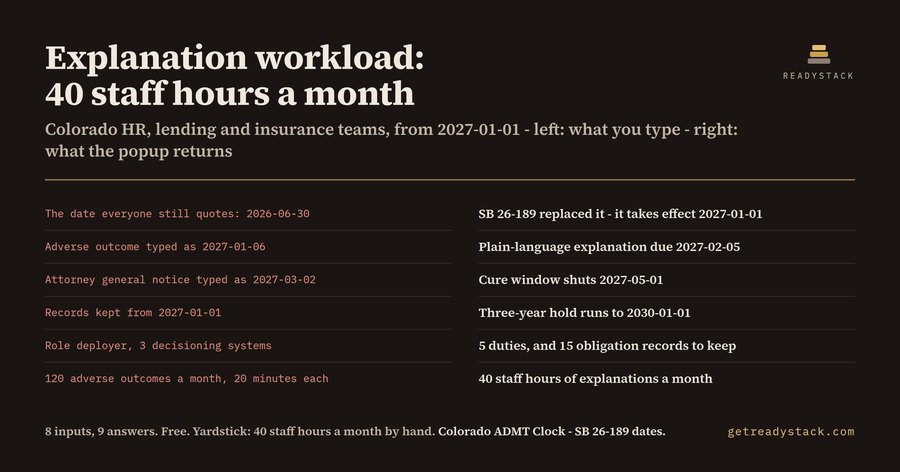
Worked example, the defaults it ships with. Count from 2026-09-21: 102 days to 2027-01-01. An adverse outcome on 2027-01-06 makes the plain-language explanation due 2027-02-05. An attorney general notice dated 2027-03-02 closes the cure window on 2027-05-01. Records kept from 2027-01-01 are held until 2030-01-01. As a deployer you carry 5 duties; across 3 decisioning systems that is 15 obligation-by-system records. And at 120 adverse outcomes a month, 20 minutes of writing each, the explanation duty alone is 40 staff hours a month.
Change one input and the answers move. A software vendor that only builds the technology is a developer, not a deployer: 3 duties, not 5. A company that does both carries 7. Count from 2027-01-15 instead and the days to the effective date turn negative - the law is already running, and the only clock left is the one on your desk.
Who this is for: the Colorado employer whose applicant tracking system scores candidates, the credit union whose underwriting model declines a member, the insurer or landlord whose software sorts applications, and the vendors that sell those systems into Colorado. A calendar app cannot count 60 days from a notice letter you have not received yet, and a chatbot cannot tell you which of the duty lists you are standing in.
The free layer is the whole calculation: every date, every count, in the extension popup and on a free web page that runs the same code, with no key, no limit and no watermark. The full version is 60 dollars once, and it changes axis rather than crippling the free answer - it exports the worked result as a .csv row you keep, and it sets reminders 30 days, 14 days and one day before each deadline you entered. Hand-writing one 30-day explanation takes about 20 minutes; at 120 outcomes a month that is 40 staff hours before anyone has checked a single date.
Install it, put your own adverse outcome date in the box, and see how many days you actually have.
Questions people ask
What does Colorado ADMT Clock actually do?
It turns your own dates into the deadlines Colorado SB 26-189 sets: the days left to the 2027-01-01 effective date, the plain-language explanation due 30 days after an adverse outcome, the last day of the 60-day attorney general cure window, and the day the three-year record hold ends. It also counts the duties your role carries.
Who is this for?
Colorado HR, lending, housing, insurance and education teams whose software screens applicants, and the vendors that build that software. A deployer carries 5 duties under SB 26-189, a developer 3, and a company that is both carries 7. The extension asks which one you are before it counts anything, because the answer changes.
Why will a chatbot not answer this correctly?
Ask one and you usually get 2026-02-01 or 2026-06-30. Both are dead. SB 25B-004 moved the old Colorado AI Act to 2026-06-30, then SB 26-189, signed 2026-05-14, replaced it with a 2027-01-01 date and dropped the impact assessments people still plan for. No chatbot counts a 60-day cure window from your notice date either.
What is free and what does the full version add?
Free: every date and count, in the popup and on the web page, with no key, no limit and no watermark. The full version, 60 dollars once, adds two things the free layer never does. It exports the worked result as a .csv row you keep, and it sets reminders 30 days, 14 days and one day before each deadline you entered.
What does this cost compared with doing it by hand?
Hand-writing one 30-day ADMT explanation takes about 20 minutes. At 120 adverse outcomes a month that is 40 staff hours before anyone has checked a single date. The extension does the date arithmetic in one click, and the full version keeps the .csv trail that a 60-day cure letter will ask you to produce.
Ask about this tool
One question, answered by the person who built it. Your email only if you want the answer sent.